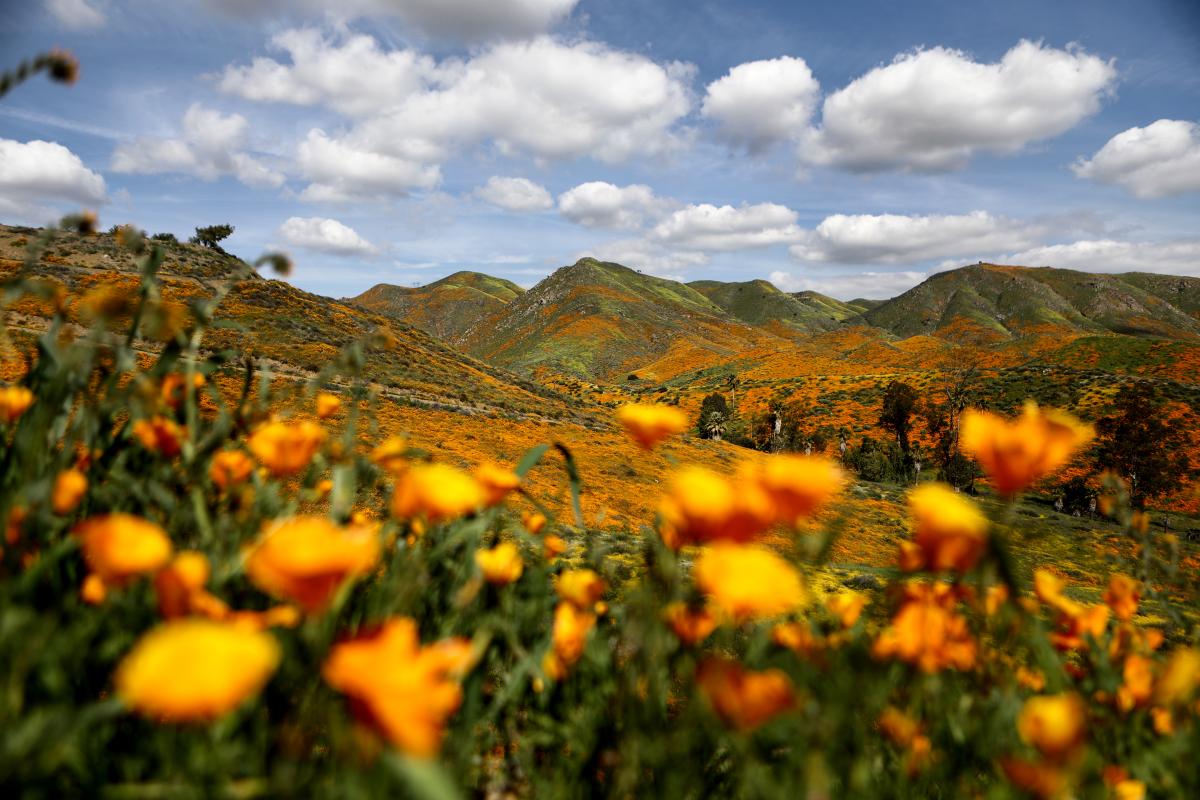

Southern California’s unusually moist winter has primed the deserts for an above-average wildflower bloom, with Loss of life Valley already displaying its strongest show in years — although consultants cease in need of calling it a real “superbloom.”
Specialists say the bloom in Loss of life Valley Nationwide Park might be the strongest in a decade, with colour anticipated to final into mid-to-late March at decrease elevations alongside Badwater Highway and Freeway 190.
“We’re having an above-average bloom 12 months,” the Nationwide Park Service stated in an replace posted on Sunday.
“Though there aren’t as many flowers as in previous ‘superbloom’ years, there are way more flowers than we’ve most years.”
The NPS added that “low-elevation flowers are blooming all through the park and can probably persist till mid-late March, relying on the climate.”
“Larger elevations could have blooms April-June.”
The optimism surrounding this 12 months’s bloom is rooted in onerous numbers.
As of Sunday, Downtown Los Angeles had recorded 18.36 inches of rain since Oct. 1 — 84% above the conventional mark — whereas Burbank logged 18.90 inches, or 202% of common.
Even arid Loss of life Valley Nationwide Park measured 2.54 inches over the identical interval, additionally 202% of regular, following what park officers described because the wettest fall on report.
These totals mark the form of sustained, well-timed precipitation that traditionally units the stage for an above-average wildflower season.
Loss of life Valley’s 2016 wildflower explosion stays the trendy benchmark for a real “superbloom,” when uncommon, completely timed winter storms reworked huge stretches of desert into sweeping carpets of colour.
The occasion — linked to a powerful El Niño sample — produced landscape-scale shows that drew a surge of tourists, with March attendance leaping 37% in contrast with the earlier 12 months.
Park officers later described the phenomenon as a roughly once-a-decade incidence pushed by unusually constant rainfall adopted by favorable spring temperatures.
The distinction between 2016 and 2025–2026 is stark. In the course of the Oct. 1–Feb. 29 window previous the famed 2016 Loss of life Valley superbloom, the Loss of life Valley–space station recorded simply 1.44 inches of rain — about 104% of regular — whereas Los Angeles websites have been working effectively under common at roughly 46% to 52% of regular.
By comparability, the 2025–2026 season so far is dramatically wetter.
Even so, extra rain doesn’t robotically imply a superbloom. Park officers stress that timing and spacing matter as a lot as uncooked totals: soaking fall storms have to be adopted by regular winter moisture to maintain seedlings alive, whereas warmth spikes or robust spring winds can shortly dry out blooms earlier than they unfold throughout the panorama.
In 2016, Loss of life Valley’s bloom was fueled by well-timed early rain regardless of modest general totals, underscoring that precipitation alone is just a part of the equation.
Professor Erica Newman, a plant ecologist at James Madison College, informed the California Submit that so-called superblooms usually happen “perhaps like as soon as each ten years or so” and rely upon excess of rainfall totals alone.
“It’s a mixture of numerous rainfall throughout California’s wet season, which is the winter — extra rainfall than regular — but additionally the sequence of ecological cues, together with temperature, that permits for lots of germination,” Newman stated.
“It’s fairly doable that we are going to have a brilliant bloom this 12 months due to the moisture,” she added.
“However as a result of there are such a lot of elements that go into this tremendous bloom, we don’t know the way to predict for certain that it’ll occur.”
“There are such a lot of elements — air temperature, soil temperature, the shortage of freezes. Even robust winds can forestall a brilliant bloom as a result of they’ll harm younger vegetation.”
Newman additionally famous that the time period itself lacks a proper scientific definition.
“It’s form of a made-up time period for this huge ecological occasion that typically occurs and typically doesn’t,” she stated.
“It doesn’t have a definition — it’s not performed by extent, it’s not performed by depend, it’s not performed by variety of species.”
