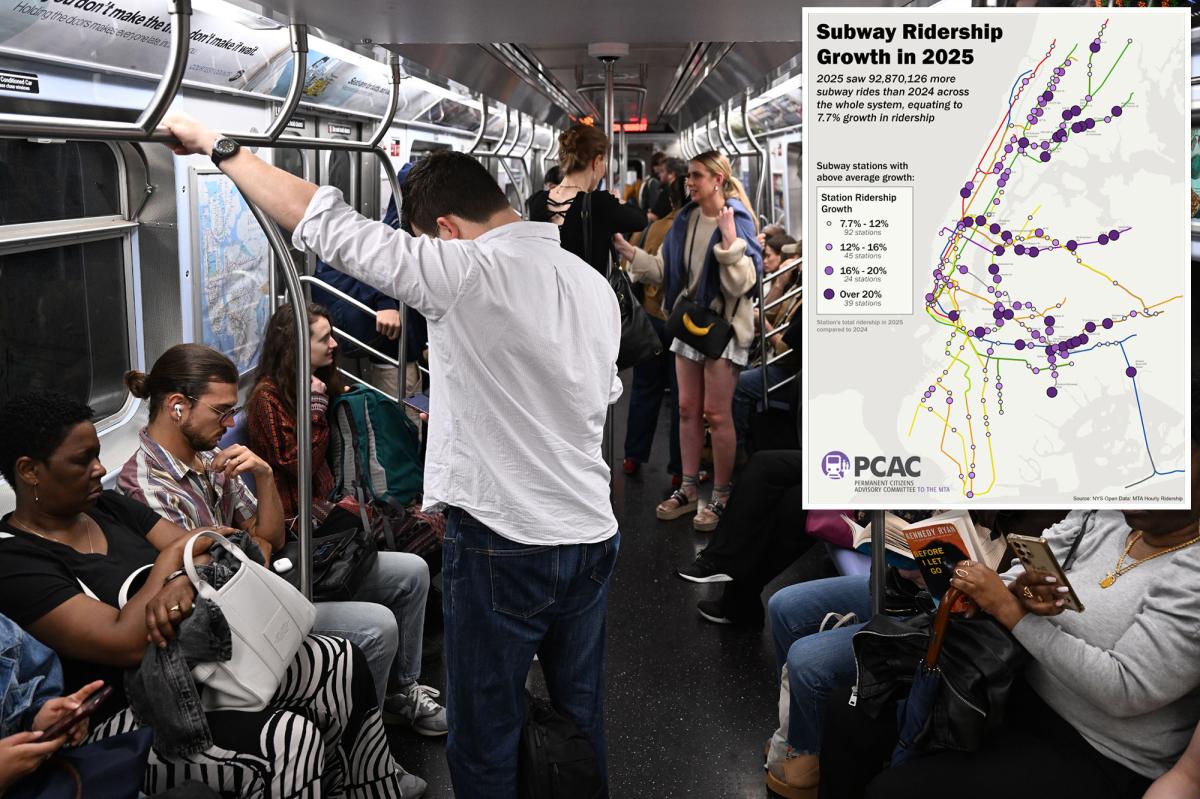

Subway ridership nonetheless trails pre-COVID pandemic ranges — by a whopping 25% — whilst transit officers rush to credit score congestion pricing for getting New Yorkers again on the general public transportation system.
A current report from the Everlasting Residents Advisory Committee to the MTA (PCAC), finds that New Yorkers took practically 1.3 billion subway journeys in 2025, about 7.7% greater than in 2024.
However subway ridership nonetheless stays at solely about 75% of pre-pandemic ranges, leaving a large hole within the system’s restoration.
The report confirmed that ridership had been climbing for years, lengthy earlier than congestion pricing started on Jan. 5, 2025.
Nonetheless, the advocacy group, in addition to Gov. Kathy Hochul and Metropolitan Transportation Authority leaders have solid the scheme charging drivers $9 to drive in Manhattan under sixtieth Road as a key purpose riders are coming again.
“Speeds are up. Buses are quicker. Transit ridership is up within the zone as properly,” Hochul stated at a Jan. 5 press convention marking the primary anniversary of the toll.
A press launch from the governor’s workplace about congestion pricing additionally touted a rise in subway ridership.
MTA chair Janno Lieber, talking on the similar press convention, labeled this system “good authorities in motion.”
“At this level, I dare say anybody who’s paying consideration and has a pulse is conscious that congestion pricing has delivered and continues to ship on all the acknowledged objectives,” Lieber stated.
Brian Fritsch, affiliate director at PCAC, even instructed Bloomberg in an article revealed Tuesday that the brand new toll prompted extra drivers to take the subway as a substitute of getting behind the wheel for each work and private journey.
“It’s much less concerning the Monday by way of Thursday — the brand new work week — which had a barely slower development yr over yr, and extra about journeys that folks might need determined to make by automotive beforehand that they’re now doing through transit,” Fritsch claimed to the outlet.
However PCAC’s evaluation incorporates no information displaying the brand new toll was the primary driver of final yr’s ridership improve.
It notes as a substitute that ridership had already been rising yr after yr from its 2020 low, and that development since 2024 has been strongest exterior of Manhattan.
Between 2024 and 2025, subway ridership rose 11.4% in The Bronx, 8.5% in Brooklyn and seven.3% in Queens, in contrast with a 7% improve in Manhattan — that means outer‑borough stations exterior the congestion zone noticed broader features.
PCAC’s report confirmed a gradual improve in ridership even within the years previous to the congestion price.
After subway use collapsed in 2020 — down 62% from the 1.7 billion subway journeys taken in 2019 — ridership rebounded to 48% of pre‑COVID ranges in 2021; 56% in 2022; 65% in 2023; 70% in 2024; and reached 75% in 2025.
MTA information additionally confirmed annual subway journeys grew 18.8% in 2021; 33.3% in 2022; 13.7% in 2023; and three.7% in 2024 — earlier than leaping 7.7% in 2025.
PCAC additionally experiences that weekend ridership is rising quicker than weekday ridership, suggesting leisure journeys stay a giant a part of the rebound.
An MTA spokesperson pointed to a ridership improve on the Occasions Sq.-42nd Road subway station, which had 2.5 million extra rides taken in 2025 in comparison with the earlier yr, as proof of congestion pricing success.
“We agree with the PCAC’s findings that congestion aid has been a powerful success and that there been a rise in subway ridership contained in the congestion aid zone and out of doors the zone.”
