
They received’t be “over” the moon even after getting back from it.
Following their historic 10-day flight across the moon, the intrepid Artemis II astronauts are slated to return to Earth Friday night, marking the top of the US’ first lunar foray in over 50 years.
However they received’t be out of the woods but — the moonstruck house explorers must cope with a precarious splashdown and a number of residual well being results.
“With eyes closed, it was virtually unattainable to stroll in a straight line,” NASA astronaut Andreas Mogensen beforehand mentioned whereas recalling the unwanted effects following a 200-day stint in house in 2024 as a part of NASA’s SpaceX Crew-7 mission.
The Artemis II crew — comprised of Reid Wiseman, Victor Glover and Christina Koch and Canadian astronaut Jeremy Hansen — is presently approaching the essential and extremely harmful level within the journey the place they’ll be reentering Earth’s environment at 25,000 miles per hour on Friday, April 10.
Their survival will rely on Orion’s 16½-foot-wide warmth protect, which must endure temperatures of 5,000 levels Fahrenheit. It is a precarious prospect, on condition that the fireplace forcefield is a useless ringer for the element current on the uncrewed Artemis I, which returned broken with a bit lacking from it.
Joyful water landings
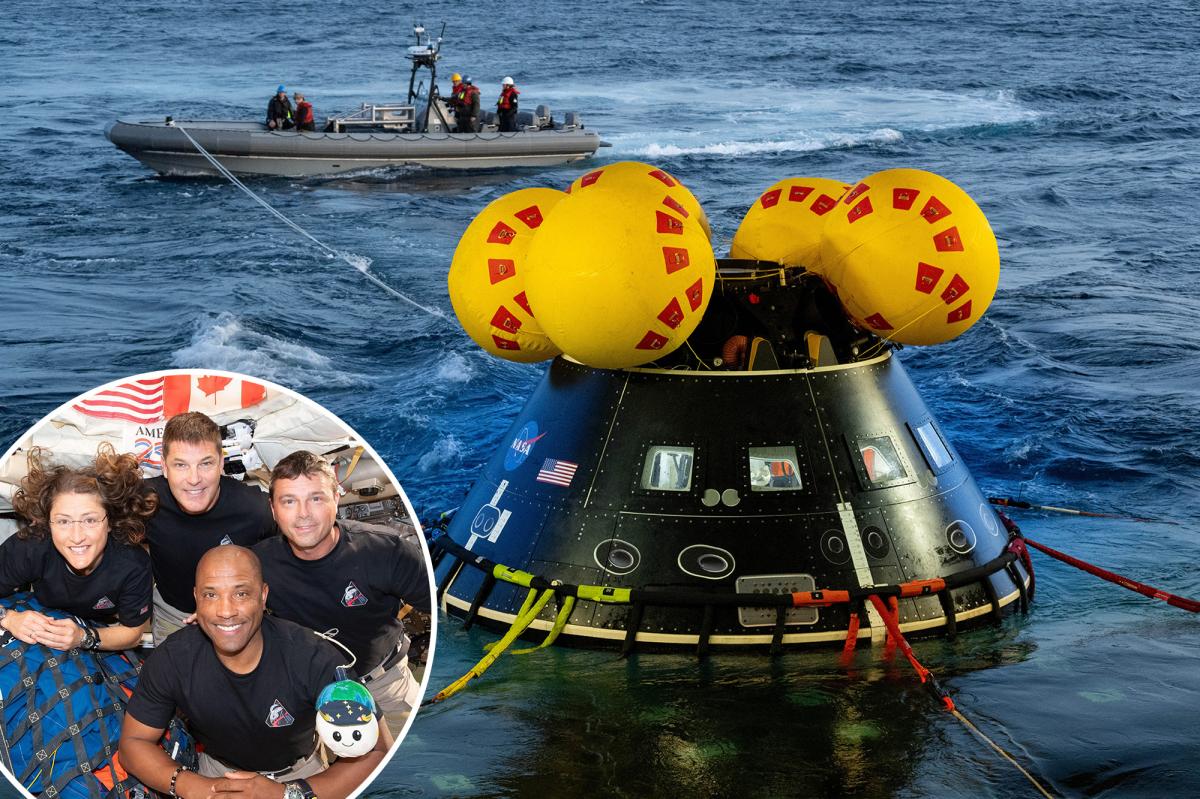
If all goes properly in the course of the journey, which marks the furthest people have ever flown from Earth at over 252,756 miles, the Orion can be descending beneath parachutes earlier than splashing down that very same day at 8:07 EST off the coast of San Diego, Fox Information reported.
Upon arrival, the astronauts will energy down the spacecraft, after which their retrieval is within the Division of Struggle’s arms.
“Then that’s the place my job is available in, of recovering the crew module alongside all the opposite NASA and Amentum staff we have now on the ship,” mentioned Jason Endsley, the lead floor instrumentation engineer with Amentum, NASA’s superior engineering companion, which presides over the retrieval.
This implies outfitting the Orion with a particular stabilizing collar to maintain it upright in oft-tumultuous seas — though the forecast is evident in the meanwhile.
After popping the hatch, the crew can be assessed by US Navy medical personnel and assisted by restoration divers onto an inflatable “entrance porch” the place they’ll don “Astronaut Restoration Vests.”
These can be used to hoist the astronauts onto HSC-23 helicopters after which delivered to the USS John P. Murtha, the place they’ll endure a checkup at a medical bay earlier than getting transported again to Houston. Each a part of the retrieval course of has to go swimmingly to keep away from any splashdown disasters.
The Orion craft, in the meantime, can be ferried to the ship through a floating dock. As soon as the module’s ashore, a truck will transport it to the Kennedy Area Middle in Merritt Island, Florida.
Feeling spacey
In fact, following the mission, astronauts can expertise of host of well being results as a result of whiplash of returning to Earth after residing in microgravity for an prolonged time period.
The change can throw astronauts’ inner-ear steadiness off kilter, as was the case with the crew of NASA’s SpaceX Crew-7 mission post-landing in 2024.
They reportedly struggled to stroll with their eyes closed after which open — one of many first exams the crew accomplished upon touching again down on residence soil. Crewmember Jasmin Moghbeli mentioned her preliminary try on the fit-mus take a look at resembled “a pleasant faucet dance.”
“I felt wobbly for the primary two days,” she mentioned. “My neck was very drained from holding up my head.”
One other facet impact was excessive nausea, with some crew members reporting not having the ability to look down with out feeling the spins.
NASA’s oldest lively astronaut Don Pettit, 70, recalled feeling queasy after returning residence in April 2025 after 220 days on the Worldwide Area Station. Whereas descending, he recalled “emptying the contents of my abdomen onto the steppes of Kazakhstan.”
Different unwanted effects embrace every part from results on the immune system, sleep disturbances and imaginative and prescient points as a result of microgravity causes blood to pool within the head, affecting the optic nerve, the BBC reported. The issue can start after simply two weeks in house.
One other aftershock? A lack of mass triggered by weightlessness in house.
After simply two weeks, muscle mass can plummet by 20% whereas astronauts lose as much as 2% of their bone density monthly as a result of their physique not requires skeletal help within the microgravity setting.
The phenomenon is much like how fish bones are skinny as a result of the animal is stored afloat partially by the buoyancy of water.
Adapting to life again on Earth
Fortunately, astronauts can fight space-related unwanted effects by sustaining strict exercise regimens on board.
To fight the atrophy, these stationed aboard the ISS have interaction in 2½ hours of day by day workout routines.
These embrace squats, deadlifts, rows and bench presses utilizing a resistive train machine, amongst different exercises.
In the meantime, the Artemis II astronauts fought bodily decline utilizing the flywheel, a customized machine that they strap their ft into and pull on straps to set off commensurate resistance, NPR reported.
Canadian astronaut Jeremy Hansen in contrast the yo-yo-like contraption to a rowing machine, claiming that you just “row at a decrease resistance and a quick tempo” for a “cardiovascular exercise.”
Typically, equilibrium is restored inside months of returning to the house planet.
“It’s wonderful how briskly the physique readjusts,” mentioned NASA astronaut Nichole Ayers, who flew her first house mission with NASA’s SpaceX Crew-10.
