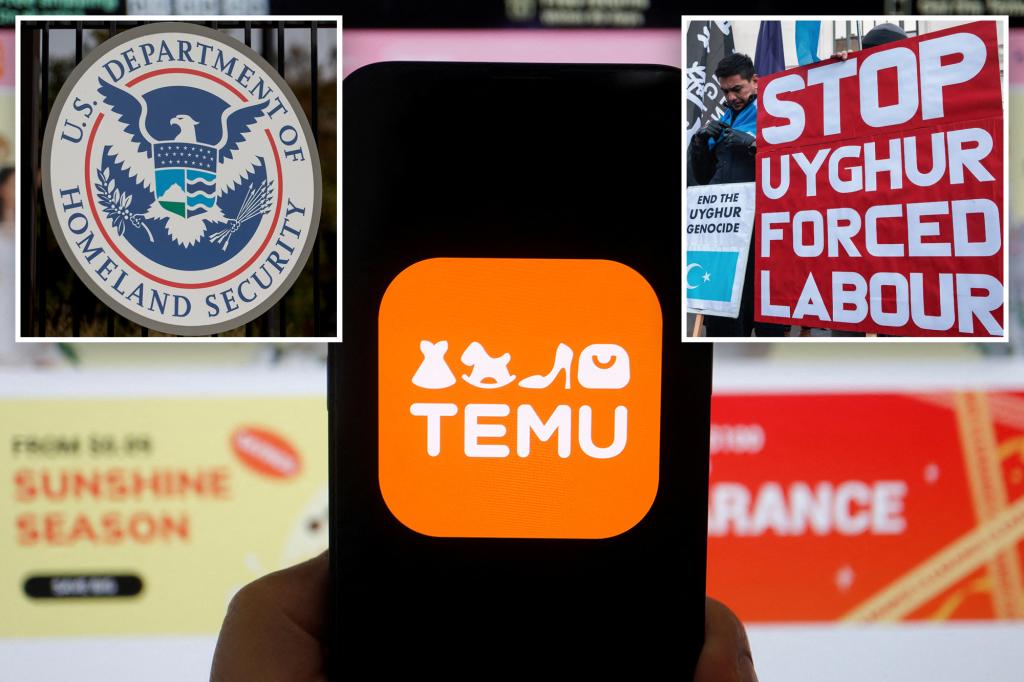

WASHINGTON — The Division of Homeland Safety is investigating Chinese language on-line retailer Temu for potential violations of the Uyghur Compelled Labor Prevention Act, which might result in a ban from promoting their wares within the US, The Publish has solely realized.
Officers and intelligence consultants inform The Publish that the too-cheap-to-beat firm performs an unfair function within the US market, spies on its cellular app customers and depends on merchandise created from slave labor to get its dirt-cheap pricing.
A senior DHS official confirmed to The Publish that the company has been investigating Temu for slave-labor violations, however the Biden administration has but to take motion towards the retailer. It was noticeably absent from a listing of 29 Chinese language firms added Friday to the US’ banned checklist for violating the UFPLA.
Drafted and superior below the Trump administration and signed into regulation by President Biden in 2021, the UFLPA outlaws the import of products “manufactured wholly or partially with compelled labor” in China, particularly from Xinjiang — residence to Uyghur Muslims that China has positioned in forced-labor camps.
Corporations discovered to have violated that provision are positioned on the UFPLA entity checklist and barred from promoting any merchandise within the US.
“[Customs and Border Protection]’s enforcement of this act is essential to making sure that items getting into the US usually are not the product of human struggling,” the company has stated.
The regulation is without doubt one of the most forceful US responses to Beijing’s “systemic use of compelled labor towards Uyghurs and different ethnic minorities within the Xinjiang Uyghur Autonomous Area,” based on CBP.
Launched in 2022, Temu has flooded the US and European markets with merchandise starting from clothes to keychains to furnishings — at only a fraction of the fee.
The web site’s bestseller on Monday, a “luxurious fake rabbit fur throw blanket,” was listed on Temu for $12.05 — lower than a 3rd of what the identical product sells for on Amazon.
Kevin Hulbert, a former senior intelligence officer within the CIA’s Directorate of Operations and CEO of XK Group Enterprise Intelligence, informed The Publish that Temu’s suspiciously low costs have alarmed officers for years.
“It’s simply unbelievable that these guys could make a gown, ship it midway all over the world and promote it for, , $8 or one thing, and so these put all kinds of US companies out of enterprise,” Hulbert stated. “After which is available in a query of how do they try this?”
“They do it most likely by having actually low-cost cotton of their items and stuff, and in order that’s a difficulty. We shockingly permit Temu to self-certify that none of their cotton comes from the Xinjiang province, which is the place slave labor’s used.”
With a brand new presidential administration on the horizon, some nationwide safety hawks are calling on the US to remove Temu’s skill “self-certify” that their firm doesn’t violate the UFLPA.
There are superior applied sciences within the intelligence sphere to show or disprove their reliance on Xinjiang-sourced items by testing the origin of some merchandise, corresponding to material, Hulbert stated. Nevertheless, it’s unclear whether or not DHS has used the tactic on objects from Temu.
“You may forensically check cotton and see the place it’s from,” he famous. “If you happen to’re sporting a cotton T-shirt proper now, for instance, I might take that cotton T-shirt off you, and I might check it forensically and let you know if that cotton was produced, grown and produced in Mississippi, Alabama, or if it was from Tajikistan, or if it was from China — or if it was particularly from the Xinjiang province in China.”
“In order that functionality’s on the market,” he added.
The Home Choose Committee on the Chinese language Communist Celebration in June 2023 referred to as on the federal authorities to analyze the CCP-linked firm in a report that alleged Temu’s enterprise mannequin permits the corporate to keep away from accountability in complying with the UFPLA until companies can show the objects have been made with out compelled labor.
“American customers ought to know that there’s a particularly excessive danger that Temu’s provide chains are contaminated with compelled labor,” the report stated.
There are additionally cyber safety dangers with customers of Temu’s cellular app that increase related issues to that which result in Congress’ ban on the social media platform, TikTok, which was accused of spying on its customers and permitting Beijing entry to the info.
A senior DHS official informed The Publish “there’s no approach I’d obtain that to my telephone.” It’s unclear whether or not these allegations are below investigation by the company.
The European Union final month launched a probe into Temu, together with whether or not the corporate violated its Digital Companies Act with practices “linked to the sale of unlawful merchandise, the possibly addictive design of the service, the programs used to advocate purchases to customers, in addition to knowledge entry for researchers.”
Reps for Temu didn’t instantly reply to a request for remark.
