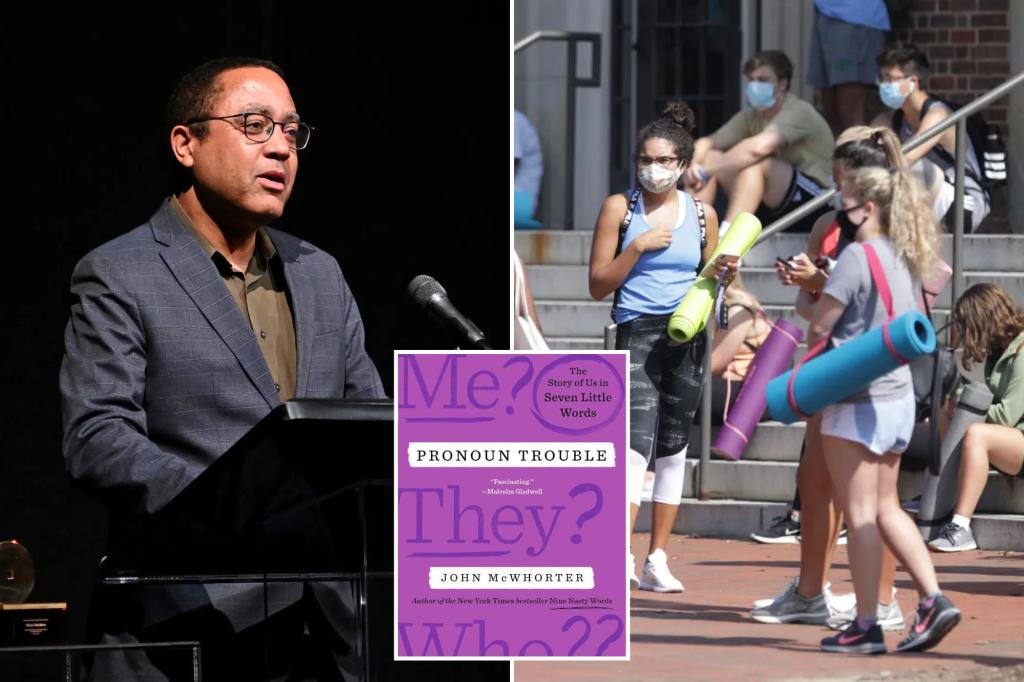

Self-described “contrarian” John McWhorter is used to being on the middle of controversy. So it’s no shock his new e-book, “Pronoun Hassle: The Story of Us in Seven Little Phrases,” hits cabinets as its topic makes fixed, contentious headlines.
However that’s not how he deliberate it.
“I’ve a sample, which is that always, if I write an offended e-book I need to write a enjoyable language-nerd e-book afterwards, simply to lighten issues up,” the Columbia prof and podcaster tells The Put up.
“Woke Racism: How a New Faith Has Betrayed Black America,” his 2021 bestseller, “was an offended little e-book that I wanted to write down. However after that’s over, you’ve received this ashtray-taste in your mouth.”
The New York Occasions — the place McWhorter is a weekly columnist — complained simply Tuesday that after President Trump “barred federal employees from itemizing their most popular pronouns in electronic mail signatures,” his “press aides have refused to have interaction with reporters’ questions as a result of the journalists listed figuring out pronouns of their electronic mail signatures.”
“Pronoun Hassle” has arrived on the excellent second.
“Sitting on a sunporch in 2023, I used to be not anticipating Trump to win once more,” its writer says. “I had no concept that a few years later, we might be caught up in these much-thornier debates about trans.”
He laughs, “I’m simply making an attempt to roll with it, however initially I used to be simply making an attempt to write down a enjoyable, completely satisfied e-book to offset the bitterness of ‘Woke Racism.’”
Whereas that e-book gained the linguist extra followers and fame, progressives hated it — and McWhorter’s work for the center-right Manhattan Institute.
Conservatives gained’t like his case for the singular “they” in “Pronoun Hassle.” However McWhorter is something however a black-and-white thinker (no pun meant).
“Phrases are going to vary typically. All of us handled ‘Oriental’ turned ‘Asian,’ and we’re a lot much less probably now to say ‘stewardess’ somewhat than ‘flight attendant,’” he says.
However the singular “they”: “That’s model new. Very very sudden. The issue is when anyone from both aspect tries to suggest a complete checklist all at one time. That’s what occurred from the woke left in 2020 and 2021, and now we have now one thing related coming from what we’re starting appropriately to name the woke proper, which is, ‘Don’t use these phrases.’”
New names don’t imply new pondering, he factors out.
“I perceive why we’re being taught now to say ‘unhoused’ as a result of ‘homeless’ has taken on a sort of a seamy air. However I’m additionally sufficiently old to recollect when ‘homeless’ was launched as a result of that sounded extra humane than saying ‘bum’ or ‘tramp,’” he says.
“Homeless was a stupendous, elegant, humane time period. However the factor is ‘unhoused’ goes to sound the identical method ‘homeless’ does now in about 20 years. Actually, what we have to change is how many individuals are ‘unhoused.’ So normally, the concept is to vary thought and actuality to not change the best way individuals say issues.”
Certainly, imposing language is simpler than working for actual change, McWhorter says.
“It’s a lazy type of activism, whichever aspect it comes from. I believe we have to get again to the concept of politics as going out and doing issues and making a case for issues somewhat than saying, ‘Don’t say that.’”
Pronouns’ ubiquity in progressives’ electronic mail signatures and social-media bios is one more type of advantage signaling.
“That has turn out to be a method of quietly indicating that you’re a sure sort of enlightened individual,” McWhorter says.
“There was a time when males wore high hats to point membership in a sure group. Even in the present day, the garments that you just put on, what radio stations you hearken to, if any, what books you may have in your shelf. So for instance, in my world, it is vitally widespread to have a replica of Robert Caro’s ‘The Energy Dealer’ very prominently displayed in your shelf. And I’m not saying individuals haven’t learn it, however you may have a method of getting that one in a spot that everybody can see, and I’d say that I’m not totally different. My copy of ‘The Energy Dealer” — and I did learn it — is someplace the place anyone who walks in can see it. That’s a method of exhibiting I’m a sure sort of educated individual.”
Itemizing pronouns, nevertheless, is one sign McWhorter would by no means ship. And that Alexandria Ocasio-Cortez deleted hers from her Twitter bio after the 2024 election sends its personal sign.
“It was exhibiting that the foremost excessive wokeness of 2020-2021 is on the ropes,” he says.
Pronoun-listing “has a scent of the onerous woke left. To the extent that Trump or Trump’s individuals had that nasty however really intelligent signal, which was ‘Donald Trump is for you. Kamala Harris is for them.’ That’s nasty, but it surely’s additionally very efficient.”
“It made sense” AOC dropped the “she/her” after the Democrats’ defeat.
“An period is over when it comes to the worst of the woke left,” he concludes. “That’s a sort of individual and beliefs that may at all times be with us ultimately, and I believe it ought to be, however there’s an excessive that I believe will move.”
McWhorter’s tolerance of the woke left is perhaps shocking, given his essential work by itself intolerance. However he’s a John Stuart Mill-type liberal — open change is how human beings be taught and enhance society.
“We’d like voices from the onerous left to develop our sense of what’s potential, to develop our sense of what ought to be potential, or what we is perhaps occupied with,” he says.
“That’s how new concepts get out. What was inappropriate was that sort of individual standing up on the desk and insisting everyone go their method on the ache of being embarrassed in public and shedding their job. That was not the best way a mature society operates. However no, I’m all for the onerous left being one in every of our voices, so long as the onerous left listens to everyone else, similar to everyone else listens to them.”
Would he say that concerning the onerous proper?
“Sure, undoubtedly, so long as they simply keep seated with everyone else,” he responds. “I grew up and I stay in a context through which I’m skilled to viscerally resist something from the onerous proper, however then once more, I additionally know intellectually that there are issues from the onerous proper that make sense.”
Requested for an instance, he pauses a while earlier than answering — he may be cautious that method.
“I don’t need to get in hassle,” he says with a chuckle.
“OK, someone from that world may say that there ought to be no such factor in admissions or in employment as acknowledging individuals’s hardships and reducing requirements in any respect. So even when it’s not about race, I’d say if someone has had obstacles, you then modify for that when evaluating whether or not or not they need to have a shot at Harvard, whether or not or not they need to get sure sorts of jobs. I say that partly as a result of it makes excellent sense to me. I say it partly as a result of it’s all I’ve ever heard. I say it partly as a result of I do know it’s what I’m speculated to say.”
McWhorter grew up in Philadelphia and has levels from Rutgers, New York College and Stanford.
“An individual from the onerous proper may say that there ought to be no changes by any means, and that entire thought that you just modify — it begins in about 1966 — was a mistake, that it’s extra hassle than it’s price,” he continues. “Make it’s a couple of check, as if we have been in an East Asian nation. And admittedly, individuals who don’t do properly will simply get higher at it, as a result of there’s no different method.”
McWhorter shakes his head. “I discover that heartless and pointless, however that’s one thing somebody ought to be allowed to say with out being thrown out on the grime as a result of, actually, a society may run extra easily primarily based on that.”
He’s on depart this yr from Columbia, the place he strongly feels anti-Israel protests have gone too far: “Jews are supposed to have the ability to suck up horrible issues being mentioned about them and Israel, day in and day trip, as a result of Jews are white.”
However he observed a disturbing pupil pattern earlier, post-COVID: the mumbling.
“It began when the masks lastly got here off. I needed to begin and I needed to carry on asking individuals to repeat themselves, like, ‘What, what?’ And I assumed, I’m not that previous. My listening to is simply advantageous. Lots of the blokes mumble, and I believe that the explanation they mumble greater than they used to is as a result of they spent a formative time period having their entire social life be on-line, the place you don’t actually have to talk up. And they also by no means discovered how to do that. And so I’m now ready for the undergraduate males to sound vaguely like they’re talking Swedish,” he says (speaking to The Put up in a Swedish café). “Ladies are extra exact of their speech often.”
He can’t assist however recall his personal daughters, although, as he considers his two roles — educational linguist who chronicles altering utilization with out judgment and opinionated commentator.
“In listening to my 10- and my 13-year-old saying ‘like’ each 5 phrases, I need to admit . . . I want typically they wouldn’t use it a lot. And I had informed them, ‘For those who’re ever in formal circumstances, like talking up in school, you might want to say ‘like’ much less,” he reveals.
“Frankly, there’s just a little little bit of snobbery,” he confesses. “I’m pondering, ‘How dare they sound like different individuals.’ However I do know that doesn’t make any logical sense. So yeah, the humanity does slip out” from the educational within the ivory tower, he chuckles.
