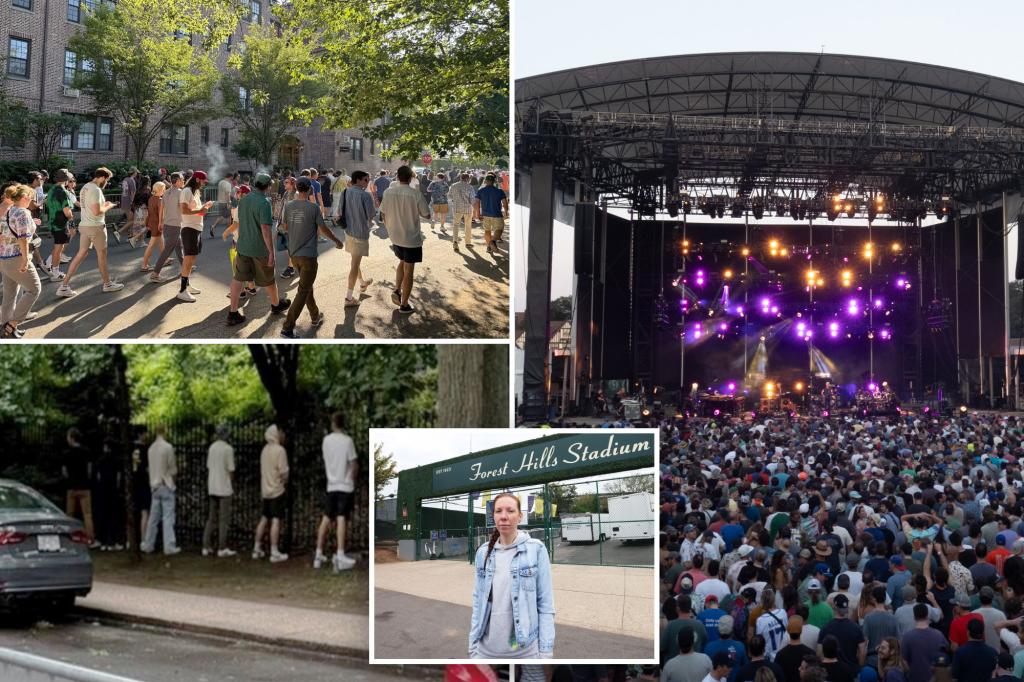

Fed-up Forest Hills residents are taking their battle in opposition to the neighborhood’s namesake live performance corridor to a brand new stage — suing the NYPD over what they declare is an unlawful takeover of personal streets, The Submit has discovered.
The Forest Hills Backyard Company (FHGC) filed a federal lawsuit in opposition to town, alleging that police “unconstitutionally” took management of the home-owner group’s property on greater than 30 live performance days this summer season to assist the Forest Hills Stadium rake in hundreds of thousands of {dollars}.
“It’s probably not a dispute between the Forest Hills Gardens and the stadium,” defined Katherine Rosenfield, a accomplice at Emery Celli Brinckerhoff Abady Ward & Maazel LLP, the agency representing the FHGC, instructed The Submit.
“It’s in regards to the metropolis taking individuals’s property with out paying for it to do no matter it’s doing.”
The FHGC and its almost 4,000 members are in search of compensation for the takeover, which has but to be decided, however attorneys theorize it might be up into the hundreds of thousands.
The NYPD allegedly took management of the streets to facilitate crowd management and site visitors course throughout live performance days, because it has in years previous, in Could, regardless of the FHGC rescinding its approval permitting the police to take action.
The denial initially meant that the NYPD couldn’t give the stadium permits that may permit it to placed on its dozens of deliberate reveals — however the pair finally struck a deal that may permit the music to play with out the cooperation of the FHGC.
“It’s simply actually problematic. If this have been occurring on a public avenue, the live performance promoter would have needed to apply for permits and pay town these charges, however as a result of it occurs to be on our non-public avenue, town isn’t getting paid and town just isn’t paying us, the consumer. One thing is amiss right here,” defined Rosenfield.
“The neighborhood has been just about devastated by this and it is a final resort, this lawsuit in opposition to town. They don’t wish to do that.”
Organizers usually pay $25,000 per day to close down streets on the same scale to what the NYPD was doing on FHGC property, based on town’s allowing coverage.
Plus, there are the charges for the cleanup for the trash left behind by the live performance goers, who’ve been caught ingesting, smoking and urinating on the non-public blocks throughout live performance days.
However the primary challenge lies with the NYPD utterly blocking the non-public roads to site visitors, which suggests even FHGC owners are denied entry to their very own driveways, based on the criticism.
In a single excessive case, an aged girl suffered an harm when she tripped whereas carrying a number of luggage and baggage for a number of blocks when cops refused to let her taxi drop her off at her dwelling, the lawsuit states.
The NYPD, nonetheless, didn’t touch upon the claims, however instructed The Submit cops solely follow public streets.
Jenna Cavuto is certainly one of dozens of residents who’ve merely chosen to spend live performance nights at a household’s dwelling or at a lodge room to keep away from the headache altogether.
“To even simply stroll down my sidewalk to get to Austin Avenue and to must undergo safety checkpoints and to must undergo 13,000 individuals, it’s laborious … Typically I determine that I don’t have the power to undergo all of that,” stated Cavuto, 33, a Lengthy Island public faculty instructor.
“Simply to plan a visit, I’ve to maintain these items in consideration. It’s important to plan your life round when the concert events are, and fairly frankly, I’m actually having bother understanding why residents are being put within the place {that a} non-public enterprise is dictating our day-to-day lives.”
Cavuto, who moved to the Gardens in 2018, hopes that the lawsuit will open the Forest Hills Stadium’s eyes to the nuisances its concert events pose to its fast group, which shares property with the tennis membership it operates from.
Not everybody in FHGC agrees with the escalation of the bitter battle between the home-owner’s group and the stadium, nonetheless.
Mitchell Cohen, the previous president of the FHGC referred to as the most recent lawsuit “a disgrace” and claimed it was largely pushed via by the board.
“As a Gardens resident, it’s irritating to see how our Board purposely blocked the NYPD from offering safety to our neighborhood, and much more perplexing now that they’re suing the Metropolis of New York for responding to the scenario they themselves created. The overwhelming majority of Forest Hills needs the Stadium to achieve success, it’s a disgrace how a number of egocentric members of the Group can waste a lot money and time attempting to kill one thing so many love,” Cohen instructed The Submit.
Tiebreaker Productions, the manufacturing firm that runs the concert events, declined to remark, and the Mayor’s Workplace didn’t instantly reply to inquiries.
The lawsuit marks the third by Forest Hills residents of their conflict in opposition to the Forest Hills Stadium and Tiebreaker Productions.
The earlier two immediately focused the stadium and centered round alleged house-rattling noise ranges emitted throughout concert events. The Division of Environmental Safety slapped the stadium with at the very least six violations from this previous summer season season, down from final yr’s 11.
Tiebreaker and the stadium have repeatedly asserted that it follows the strict directions put forth by FHCP — together with slicing concert events off at its 10 pm curfew — and have a big assist following in the neighborhood exterior of FHGC, together with from retailers who say the concert events usher in a significant income stream.
