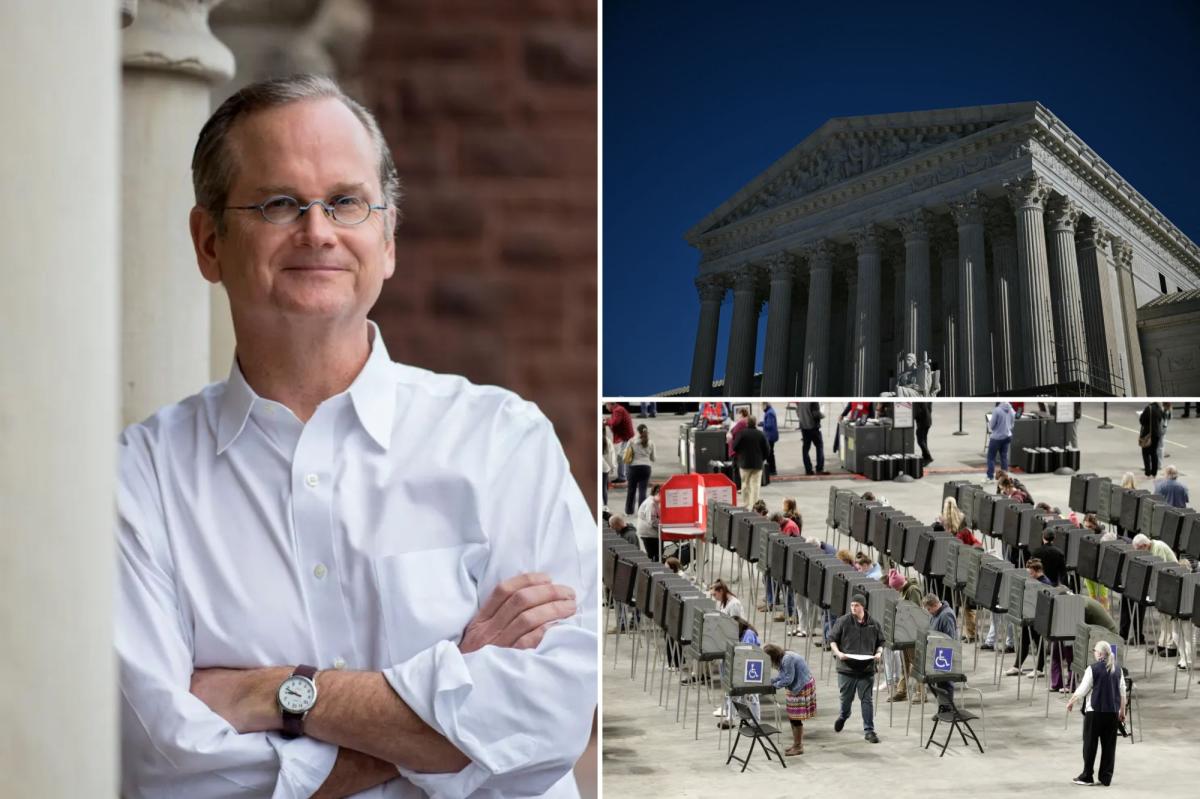

WASHINGTON — Maine has develop into a staging floor for the most recent battle to finish the observe of limitless tremendous PAC donations that has dominated American politics for the previous 15 years.
In 2024, voters within the Pine Tree State, by a margin of virtually three-to-one, permitted a poll initiative limiting tremendous PAC donations to $5,000 per individual or entity.
“It demonstrates that it is a deeply purple concern; there was no distinction within the leads to purple districts or blue districts,” stated Lawrence Lessig, a Harvard Legislation Faculty professor whose nonprofit Equal Residents is main the trouble to defend the referendum.
The following authorized battle — Dinner Desk Motion v. Schneider — has emerged as one of the vital consequential scrums over cash in politics lately and will radically rework the 2028 presidential election.
In July, Portland federal decide Karen Frink Wolf struck down the marketing campaign finance restrictions created by the poll measure, ruling that they violated the First Modification “as a result of there isn’t a set of circumstances the place they might be utilized constitutionally.”
Lessig decried Wolf’s ruling as “probably the most excessive opinion ever within the historical past of the federal judiciary,” claiming that it discovered that “even in case you can see there’s a threat of corruption, there’s nothing the state can do about it.”
The ruling has been appealed and is pending earlier than the Boston-based First Circuit Courtroom of Appeals.
Tremendous PACs emerged as a phenomenon proper after the Supreme Courtroom’s landmark Residents United v. Federal Election Fee (FEC) resolution in January 2010, which eradicated federal limits on particular person or company spending in elections.
Since then, tens of billions of {dollars} have been pumped into campaigns, with greater than $5.1 billion being raised by tremendous PACs in 2024, in response to an evaluation from OpenSecrets — dwarfing that of principal marketing campaign committees, that are topic to caps on particular person donations.
“The Supreme Courtroom’s not going to reverse Residents United,” Lessig pressured. “Certainly, all it has to do is to use the reasoning of Residents United as a result of what Residents United stated is … if there’s a threat of corruption, you possibly can regulate.”
Wolf was not satisfied, writing in her ruling: “If the federal government’s curiosity in combatting the looks of corruption was not sufficient to justify limits on unbiased expenditures, it stands to cause that the identical curiosity isn’t sufficient to justify limits on contributions to unbiased expenditures.”
The Supreme Courtroom by no means explicitly dominated whether or not caps or restrictions on donations to tremendous PACs are unconstitutional. That fell to the DC Circuit Courtroom of Appeals, which dominated two months after Residents United was determined that “the federal government has no anti-corruption curiosity in limiting contributions to an unbiased expenditure group.”
Since then, at the least seven different appeals courts have unanimously slapped down independent-expenditure contribution limits as unconstitutional, in response to a short by the Institute for Free Speech (IFS), which is preventing towards the Maine initiative.
“I give it a 0% likelihood of success,” IFS senior legal professional Charles Miller informed The Submit about Lessig’s newest effort. “That is basically repackaging outdated arguments which have failed again and again.
“They’ve added extra splash to it this time and a little bit bit extra kind of a PR polish to it, however it’s the identical substantive arguments.”
Restrictions on political donations “may be very engaging within the summary,” former FEC Chairman Allen Dickerson acknowledged.
“But when you concentrate on the place that considering leads, it’s not apparent that these contribution limits would solely apply to political committees and to not different ideological organizations.”
Dickerson warns that if the boundaries imposed by Maine’s referendum are allowed to face, “the principal means by which strange individuals can pool their cash to take out advertisements and communicate independently about politics could be reduce off.”
“The billionaires and the multi-millionaires and the massive organizations would nonetheless be capable of do this straight,” he added, arguing that middle-class Individuals wouldn’t have the means of shopping for TV advertisements with out pooling cash.
Proper now, Lessig is just preventing to restrict donations to tremendous PACs, not remove them altogether. The Maine referendum would nonetheless enable strange Individuals to pool funds collectively for political functions.
However the professor believes that the rise of tremendous PACs with limitless donations has dramatically shrunk “the variety of related funders” to the purpose the place “candidates are most attuned to” an “more and more small variety of billionaires.”
Lessig and his allies argue that the federal government can prohibit donations to tremendous PACs identical to Supreme Courtroom precedent permits limits on particular person donations to campaigns.
However he concedes that the feds gained’t be capable of prohibit election spending by people that doesn’t undergo third events like campaigns and tremendous PACs, established by the excessive court docket in 1976’s Buckley v. Valeo.
Buckley struck down limits on what candidates can spend on their very own campaigns, however allowed caps on donations from outdoors people resulting from quid professional quo considerations.
“What we gained’t obtain is the tip of the chance for someone like George Soros … or Elon Musk to spend cash independently on their very own,” stated Lessig.
Dickerson responded: “If a person can spend limitless funds to elect a candidate — independently, once more, of that candidate, not a contribution — then it have to be true you can create organizations that pool individuals’s cash” to assist elect them.
“We reject the proposition that proscribing cash in politics is an effective aim in and of itself,” stated Miller. “…It would at all times be the case that elites will at all times have extra entry to politicians. You understand that’s innate in any system of presidency.”
There’s an open query about whether or not or not the Supreme Courtroom will take up Dinner Desk Motion v. Schneider, provided that the excessive court docket usually seems to be for conditions the place there’s a significant cut up within the decrease courts.
“The most important variety of individuals to vote for something within the historical past of Maine have stated they don’t need tremendous PACs,” Lessig stated, making a part of his originalist pitch.
“Why do 5 justices on the Supreme Courtroom get to disagree with that once they’re not counting on something we the individuals ever did in enacting our Structure?”
