
NEW YORK — Devices bought with out batteries. Toys bought in slimmed-down packing containers or no packaging in any respect. Extra family items that customers must assemble themselves.
These are a few of the methods client product firms are retooling their wares to scale back prices and keep away from elevating costs as President Donald Trump levies new import taxes on key buying and selling companions in addition to some supplies utilized by American producers.
The financial atmosphere during which the president has imposed, threatened and infrequently postponed repeated rounds of tariffs is extra precarious than throughout his first time period.
U.S. shoppers are feeling tapped out after a number of years of inflation. Companies say tariffs add to their bills and eat into their earnings, however they’re cautious of dropping gross sales in the event that they attempt to move the entire improve on to clients.
As a substitute, some firms are exploring cost-cutting choices, each ones that buyers probably would discover in time — keep in mind “shrinkflation?” — and ones that exist too far down the provision chain for them to see. The modifications could assist decrease value will increase but gained’t be sufficient in each case to offset them utterly.
These are a few of the methods retailers and types take note of:
A kink within the provide chain:
After placing an additional 20% tariff on all items from China, in addition to a 25% tariff on imported metal, aluminum and vehicles, Trump mentioned he would announce on Wednesday the targets of “reciprocal tariffs” that mirror the taxes all different nations apply to sure U.S. exports.
He argues the tariffs will spur home manufacturing, amongst different objectives.
Additionally on the horizon: twice-delayed tariffs on most items from Canada and Mexico, and duties on copper, lumber and pharmaceutical medication.
Kimberly Kirkendall, president of supply-chain consulting agency Worldwide Useful resource Growth, has instructed purchasers — U.S. makers of shelving, house items and meals merchandise — that given all of the uncertainty, this isn’t the time for long-term strikes like in search of factories exterior of China.
She inspired them to concentrate on the quick time period, notably the necessity to scrutinize product strains from each angle for attainable financial savings.
“You’ve obtained to collaborate and work collectively together with your suppliers on this state of affairs to have the ability to carry prices down,” Kirkendall mentioned.
Sourcing issues usually are not solely a fear for giant firms that depend on Chinese language producers. Sasha Iglehart, founding father of a small on-line clothes firm known as Shirt Story, has a group of upcycled males’s shirts that promote for round $235. She mentioned she sometimes will get her classic buttons from an Austrian provider and is aware of Trump has talked about taxing items from the European Union.
“I’ll proceed to search for native distributors and collectors right here within the States as again up,” mentioned Iglehart, whose firm relies in Connecticut.
Remodeling a product
For a lot of firms, evaluating which elements or particulars they will take away from their merchandise or exchange with inexpensive ones is the go-to transfer for absorbing the potential monetary hit from tariffs.
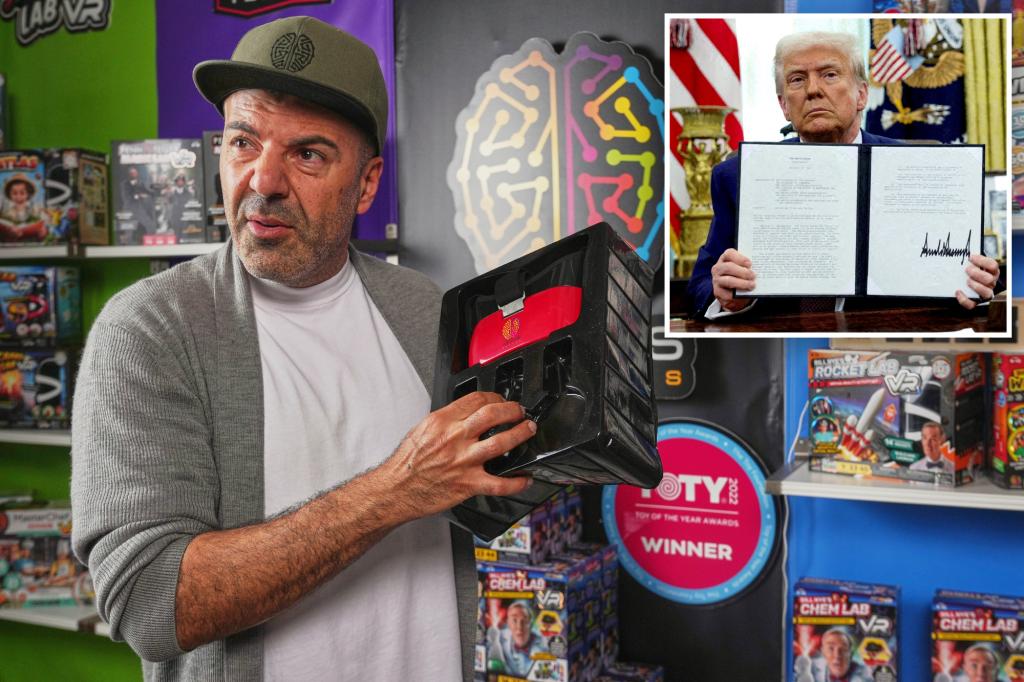
Los Angeles-based toy firm Abacus Manufacturers Inc., which designs science kits and different academic toys, has most of its merchandise made in China. By utilizing barely thinner paper in an 80-page mission e-book that comes with two of its kits, the corporate expects to avert a $10 retail value improve, President Steve Rad mentioned.
“Three or 4 cents right here,” Rad mentioned. “Seven or 6 cents there. Two extra pennies over there. Unexpectedly, you’ve made up the distinction.”
Aurora World Inc., recognized for its plush pets and toy automobiles, is taking a look at utilizing fewer paint colours as a method to counteract tariff prices, in line with Gabe Higa, managing director of the California firm’s toy division. All of Aurora World’s toys come from factories in China.
“That is one thing that makes it just a little bit easier in order that there’s much less handbook labor concerned or much less materials price,” Higa mentioned. “(It) doesn’t have quite a lot of incremental worth so it’s simple to remove.”
The corporate nonetheless could have to boost costs so long as the brand new tariffs are in impact, he mentioned.
Economic system packaging:
Tweaking or decreasing product packaging is one other space the place importers could reduce and carries the benefit of presumably interesting to eco-conscious clients.
Fundamental Enjoyable CEO Jay Foreman, whose firm markets basic toys like Tonka vans, Lincoln Logs and Care Bears, mentioned he’s presenting retailers with three totally different packaging choices and asking them to resolve which of them they like for the vans and another merchandise that will probably be in shops subsequent spring.
The primary is the present packaging, which consists of a field with a giant open window that lets clients see what’s inside. The second possibility: no field, only a tray connected to the underside of toys to carry them in place on cabinets. The third: unwrapped however affixed with a easy paper price ticket that options model info.
The second-tier packaging would scale back the toy firm’s price per merchandise by $1.25, and the package-free model would yield financial savings of $1.75, Foreman mentioned. Each would diminish the attraction of the merchandise and wouldn’t come near canceling out the tariff on items made in China, Foreman mentioned.
He mentioned he would make pricing choices later this week after Trump gives particulars about his deliberate reciprocal tariffs.
To additional scale back its manufacturing prices, Abacus Manufacturers is pondering of switching from plastic to cardboard for the package deal inserts that maintain toy elements in place. Cardboard trays price 7 cents per unit in comparison with 30 cents for the plastic model, in line with Rad.
The change requires discovering a brand new manufacturing unit to make the inserts, a transfer that didn’t make monetary sense prior to now, he mentioned. The assorted tariff-related modifications must be efficient for fall and vacation deliveries to shops, Rad mentioned.
“The compromises we’re making are issues that don’t matter to the patron,” he mentioned.
Overlook the extras
Consumers will probably should assemble extra of their merchandise at house as firms look to scale back transport prices, in line with Kirkendall of Worldwide Useful resource Growth.
One in all her purchasers manufactures self-watering planters which might be made in China. The product is present process a redesign so it may be shipped as separate nesting elements as a substitute of totally assembled.
Corporations are also reevaluating the items of their merchandise which might be important or additional. Chris Bajda, managing companion at on-line marriage ceremony present retailer Groomsday, mentioned equipment like batteries and ornamental present packing containers could find yourself within the latter class.
“We now rigorously assess what’s really obligatory and keep away from together with objects that don’t serve a useful objective for the client,” Bajda mentioned.
The return of shrinkflation?
Decreasing the dimensions or weight of merchandise with out decreasing costs proliferated as a enterprise observe from 2021 via 2024 as firms grappled with rising prices for elements, packaging, labor and transportation.
Edgar Dworsky, a client advocate and former assistant lawyer basic in Massachusetts, suspects the makers of client items will embrace shrinkflation once more to cover prices given the blast of latest tariffs. The extra import tax on Canadian mushy lumber, for instance, would possibly present up in smaller rest room paper rolls, he mentioned.
“Shrinkflation has been just a little quiet” in the previous couple of months, Dworksy mentioned. “However I’d count on to see each value will increase and product shrinkage.”
