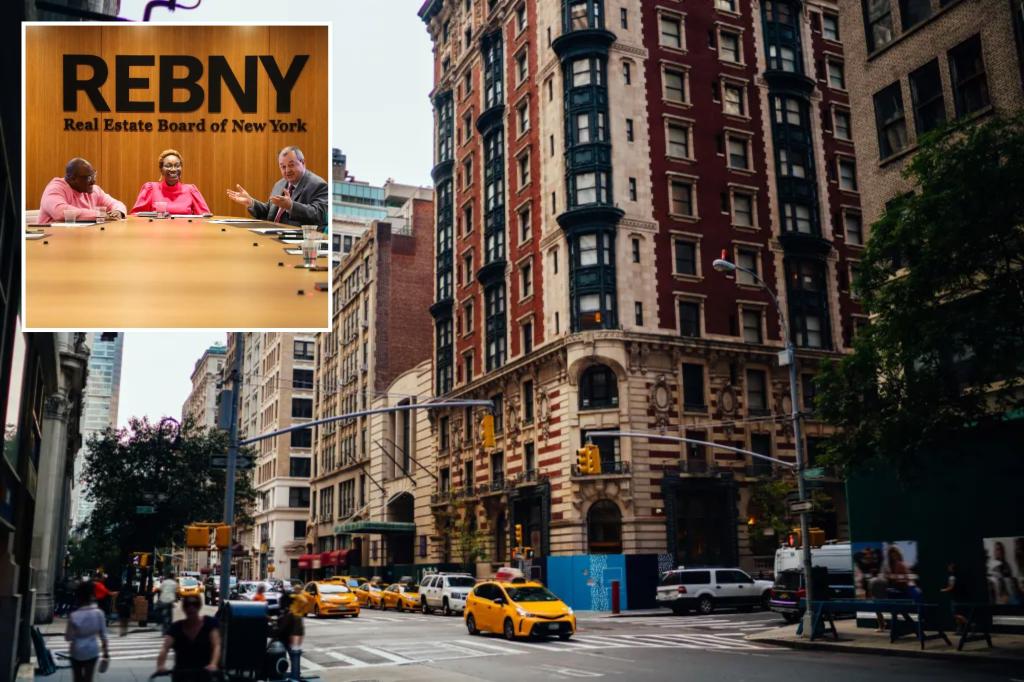

These brokers are attempting to dealer a last-minute deal.
New York Metropolis’s actual property trade is making an Eleventh-hour bid to halt a brand new regulation that shifts the burden of expensive dealer charges away from renters earlier than it takes impact subsequent month.
The Actual Property Board of New York, the town’s highly effective group of over 10,000 actual property professionals, filed a movement earlier this month in search of to place the Equity in Residence Rental Bills Act on pause till the courtroom battle over the regulation performs out.
Right here’s every part it’s essential now in regards to the new guidelines — which is able to launch on June 11 until a federal choose agrees to REBNY’s movement.
What’s the Equity in Residence Rental Bills (FARE) Act?
The FARE Act — handed in Metropolis Council with a veto-proof majority of 42-8 on Nov. 13 — prohibits brokers representing property homeowners from charging potential renters a “dealer payment.” It additionally requires that every one charges a tenant owes be included in rental agreements and actual property listings.
Proponents of the laws say it would assist ease the town’s housing disaster by reducing down prohibitive up-front prices for tenants, together with dealer charges — that are sometimes about 15% of the annual price of a rental unit, in response to actual property web site OpenIgloo.
However critics of the regulation argue landlords should still sneak in dealer charges onto tenants by increased month-to-month rents.
Andrew Lieb, managing legal professional of boutique actual property litigation regulation agency Lieb at Regulation, declares the Massive Apple rental market can be “without end modified” by the FARE Act.
“It would lead to tenants dropping entry to housing from landlords who merely determine it’s not value it to be a landlord anymore,” Lieb instructed The Submit. “New York Metropolis is basically making it unimaginable for a residential landlord to function given the plethora of crimson tape that must be navigated simply to signal a lease — after which imposing that lease is an entire different catastrophe.”
When do dealer charges go away?
Until a federal choose guidelines in any other case, landlords can be barred from passing on the payment to a tenant after June 11, even when a lease was signed earlier than the efficient date, a rep from the Division of Shopper Safety confirmed to The Submit.
New York Metropolis is likely one of the few cities the place landlords can rent a dealer and go the agent’s payment onto a tenant.
New York landlord-tenant lawyer Altagracia B. Pierre Outerbridge expects the mandate to enter impact, and {that a} federal choose is “most likely not going to dam the regulation” for the reason that courtroom hasn’t but issued a call.
“The truth that a month has handed (and the regulation goes into impact in two weeks) with out the Courtroom doing something means that it doesn’t really feel an enormous rush to become involved,” Pierre Outerbridge instructed The Submit.
Does this imply that every one dealer charges are unlawful?
Landlords and tenants can nonetheless rent their very own brokers beneath the FARE Act.
However landlords can’t shift the price of a dealer that’s “completely representing the owner’s pursuits” onto a tenant. This consists of charges for brokers who publish listings with the owner’s permission.
“The FARE Act ensures transparency for tenants to not unfairly be burdened with extra prices by putting the duty for a dealer’s charges on the get together that really employed them,” the Metropolis Council stated in a press release.
What are actual property brokers saying?
Within the lawsuit filed in December, REBNY attorneys claimed the town’s “profoundly misguided” laws violated federal and state legal guidelines, together with constitutional free speech and contract rights.
“The FARE Act is constitutionally flawed on a number of accounts. We’re assured that the Courts will agree with us,” a REBNY rep instructed The Submit.
The New York State Affiliation of Realtors additional argues the regulation would drive up rental prices, strip away “over half” of on-line rental listings and open the “floodgates for baseless lawsuits and penalties towards brokers.”
“The landlords who nonetheless wish to use a dealer and are allowed to boost the hire to accommodate the shift in duty will achieve this,” Pierre Outerbridge stated, including that some tenants are “going to be shocked to pay an additional month’s hire in dealer charges to be able to signal their lease.”
“It would exacerbate rental unaffordability,” Violetta Weddepohl, a dealer at Serhant, concurred. “Because of this, when leases come up for renewal in a 12 months or two, tenants will face even steeper hire will increase.
“I’ve sympathy for the argument that the dealer must be paid by the one who hires them,” she stated, “however the actuality is that the landlords can get away with charging increased hire.”
However actual property itemizing web site Streeteasy estimated the typical price to signal a lease on leases that may have at present charged a dealer payment will fall by 41.8% as soon as the regulation takes impact.
“Rental properties that stopped charging tenants a dealer payment prior to now didn’t enhance rents past broader market developments,” reads a December report from the positioning. “The lock-in impact of excessive upfront prices made it simpler for landlords to boost rents quicker.”
What are New York Metropolis residents saying?
New Yorkers who spoke to The Submit have been largely in favor of the regulation taking impact, with almost each native citing housing affordability as a serious concern.
“That is nice,” Betsy Laikin, a movie producer, instructed The Submit. “The rents are increased than they’ve ever been. Why ought to we pay a dealer payment, on prime of those rents?”
“I feel the dealer payment … shouldn’t exist,” Luke Atkinson, a 39-year-old painter from Bushwick, Brooklyn, added. “[Brokerage] is a job that doesn’t must exist, they usually understand it deep down of their souls.
“That’s why they’re insecure,” he added. “That’s why they’re at all times hustling as a result of it’s a job that doesn’t must exist.”
Georgi Georgiev, a bartender from Bulgaria who now resides in Fort Greene, is much less optimistic.
“A technique or one other, we’re going to pay it if we’re getting an residence, it doesn’t matter what. We’re by no means gonna not pay,” Georgiev, 45, stated. “There may be gonna be so many loopholes.”
What occurs if an residence has a dealer payment after the regulation is in impact?
Town’s Division of Shopper Safety can be imposing the regulation after it goes into impact.
It’s estimated the company would require about $500,000 within the subsequent fiscal 12 months for outreach and training associated to the regulation, in response to Metropolis Council data.
These caught in violation of the regulation can be topic to a $1,000 high-quality for the primary violation and a $2,000 high-quality for every violation inside a two-year interval.
To file a criticism concerning a FARE Act violation, customers can go to nyc.gov/customers or name 311 as soon as the regulation is in impact.
