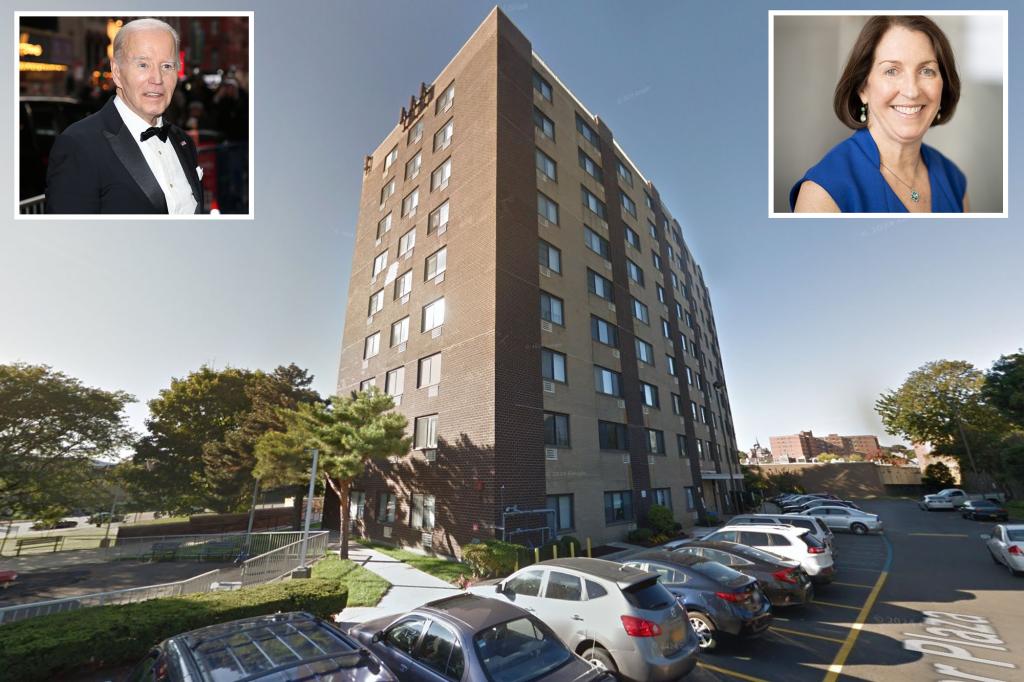

WASHINGTON — A New York lady who received practically $7 billion from a Biden administration local weather slush fund as soon as compelled by way of the sale of a low-income housing complicated in Westchester County, leading to rents spiking as much as 80% and making the fee unaffordable for a lot of, tenants say.
Sadie McKeown — a Democratic donor appointed by then-Gov. Andrew Cuomo to the boards of the state Housing Financing Company and Power Analysis and Improvement Authority in 2021 — secured $6.79 billion from the Environmental Safety Company (EPA) for her nonprofit throughout former President Joe Biden’s ultimate months in workplace.
As president of the nonprofit, the Group Preservation Company (CPC), McKeown then propped up a coalition of teams known as Local weather United to steer their reduce of the EPA’s $20 billion Greenhouse Gasoline Discount Fund into constructing climate-friendly housing and different carbon-reducing initiatives.
President Trump blocked the payouts after assuming workplace, when his EPA chief Lee Zeldin found the scheme described by one Biden administration official as “throwing gold bars off the sting” of the Titanic — and froze the funding at Citibank in Manhattan.
McKeown — whose pay at CPC peaked at $883,703 between fiscal years 2019 to 2023, per tax filings — has lengthy pursued a carbon-neutral agenda; typically, her critics cost, on the expense of her group’s “equitable” mission.
In 2020, McKeown helped dealer the sale of Asbury Terrace Residences, an inexpensive housing complicated in Tarrytown, to for-profit developer Mountco for $15.5 million.
Earlier than the sale, the complicated of greater than 100 items was owned by the Asbury Terrace Housing Improvement Fund, whose board was comprised of leaders from Tarrytown church buildings and faith-based teams and which had supplied below-market leases to low-income residents for many years.
McKeown chaired the board of that fund whereas serving concurrently on Tarrycity’s Housing Affordability Activity Drive and Municipal Housing Authority. She signed off on the Mountco buy and received rents raised after petitioning the US Division of Housing and City Improvement (HUD), in response to data filed with the Westchester County Clerk.
The December 2020 sale funneled tens of millions of {dollars} in internet proceeds to the pet tasks of one other native nonprofit, the Housing Motion Council — whose government director, Rose Noonan, was serving with McKeown on the inexpensive housing activity power.
CPC’s senior vp overseeing the Hudson Valley area, Doug Olcott, can also be a board member on the Housing Motion Council, which was tasked with approving expenditures for future tasks from a fund created by the proceeds from the Asbury Terrace sale.
McKeown instructed The Submit that “CPC had no a part of the financing at Asbury Terrace,” whereas Olcott “is a volunteer and recuses himself from something CPC-related.” McKeown did acknowledge her place on the housing growth fund’s board and claimed the sale was “a superb consequence for the residents there.”
However the Mountco acquisition resulted in hire hikes of between 70% and 80%, pushing some residents who mentioned they have been on tight budgets out of the constructing.
In the meantime, pissed off tenants — a few of whom mocked McKeown as “Shady Sadie” for her elusiveness in the course of the Mountco sale course of — say the brand new possession did virtually no renovations to the property, as would have been anticipated to justify such a big enhance.
Maddy Viruet, a single mother who at present lives within the house complicated, mentioned her funds are set to leap $1,000 to $2,352 per 30 days for her two-bedroom unit — a hike she will’t afford.
“We’ve got nowhere to go — aside from to simply pack our baggage and go away — and that’s what I believe they need us to do,” mentioned Viruet, noting that greater than two dozen different tenants, a number of of whom are single mother and father, have been dealing with the identical will increase and a few had already been compelled to maneuver out.
Greater than 80 of the items have residents on rental help, which means they’re solely required to pay as much as 30% of their revenue towards hire, whereas federal taxpayers are left protecting the rest as a part of the HUD program.
Many tenants like Viruet who don’t want to disclose their funds and apply for Part 8 rental help should pay the elevated charge, which first started to take impact in September 2024.
Haydee McCarthy, who says she lived at Asbury Terrace from round 1990 till 2007 after which once more briefly in 2015, added that her grandfather left after the sale and she or he is aware of different neighbors who’ve needed to transfer due to the hire enhance.
“Except for one or two neighbors, there was by no means any communication from the board in any respect,” McCarthy mentioned. “Most residents didn’t have any thought {that a} nonprofit existed or {that a} board existed.”
McKeown mentioned that the hire enhance was factored in “over time whereas I used to be on the board in step with HUD governance and tips.”
“The board insisted there was correct administration, which there was,” she added.
“We didn’t need anyone to have to go away the constructing — that’s simply false,” added John Madeo, the overall counsel of Mountco, who mentioned the roughly two dozen tenants not on Part 8 hire help “have been paying properly beneath what could be thought-about affordable rents within the space.”
“There was an revenue inequality within the constructing. That to us didn’t appear honest,” added Madeo, claiming that non-Part 8 tenants have been seemingly paying lower than 30% of their revenue towards hire and solely 4 tenants had accepted a suggestion from the brand new house owners to cowl the distinction for these not on the HUD program.
The 2020 sale additionally could have uncared for an settlement with HUD to tackle rehabilitation work within the complicated.
Round $5 million was speculated to go towards updating the 1971 constructing’s roofs, home windows, cupboards, home equipment, flooring, lighting, boilers and a contemporary coat of paint — however virtually none of that work was finished, leaving tenants feeling “cheated,” in response to a letter drafted for HUD’s Workplace of Inspector Common.
Madeo admitted that “we didn’t change kitchens and baths absolutely,” however insisted: “If there’s work finished poorly, we’ll re-do it.”
Critics of the sale have charged potential conflicts of curiosity — and alleged the deal violated Asbury Terrace’s articles of incorporation, which precluded housing non-low-income residents or a sale involving a for-profit entity, court docket data present.
“While you’re advocating for issues you have got a direct curiosity in, try to be recusing,” mentioned Adam Bradley, an lawyer who represented one of many faith-based teams in the course of the dispute.
“They’re screwing, in lots of instances, the those who already dwell in Tarrytown. They’re earmarking these inexpensive housing locations — as you noticed in Asbury — the place the low-income items then find yourself paying considerably extra,” he mentioned. “It’s actually earmarked for middle-income professionals.”
The New York Legal professional Common’s Workplace, nonetheless, consented to the sale and it was permitted by a state Supreme Courtroom justice.
Ethics complaints filed with Tarrytown officers point out that McKeown was allowed to serve collectively on Tarrytown’s Municipal Housing Authority and its Reasonably priced Housing Activity Drive — however needed to recuse herself beginning in 2021 from “any” deliberations of the latter.
McKeown not serves with both group.
Roughly $8 million of the Asbury Terrace sale’s proceeds, together with a $3 million mortgage from one of many Local weather United teams, have been moreover put aside to revamp Tarrytown’s YMCA with “inexpensive and energy-efficient flats” for seniors — a undertaking which was cheered earlier this month by New York Gov. Kathy Hochul upon its completion.
Tarrytown natives have expressed skepticism that both the Asbury complicated or the brand new YMCA are getting used to accommodate village residents.
At a Board of Trustees assembly final week, resident John Stiloski requested: “How many individuals from Tarrytown received in inexpensive housing on the YMCA undertaking?”
“They’re all residents of Tarrytown now, John,” Mayor Karen Brown responded.
“As soon as it turns into a state housing undertaking, anybody can come dwell in it,” Stiloski fumed to The Submit, saying the Asbury Terrace deal and different housing tasks pushed by village officers and McKeown’s nonprofit community have alienated “all of the folks of poverty and colour who really want help.”
“You may’t restrict it to simply folks in Tarrytown,” Madeo responded.
“Any state or federal housing funded, to my data, can’t be restricted to group residents.”
McKeown claimed that the YMCA is now made up of all inexpensive housing items, most of whom are lived in by seniors paying between 30% and 70% of their revenue towards hire, however inaccurately argued “CPC didn’t finance” the undertaking.
“I had no direct curiosity aside from to see new inexpensive items get developed,” she mentioned. “It was an effective way to make use of the proceeds of the sale, in step with the [Asbury Terrace Housing Development Fund] bylaws and signed off on by the AG.”
The trio of Local weather United teams that received the Biden-era slush cash included CPC Local weather Capital, Calvert Impression, and Self-Assist Local weather Capital.
“All three organizations have important expertise in financing, vitality effectivity, and inexperienced tasks in low and average revenue communities,” McKeown mentioned.
McKeown remains to be lobbying members of Congress to unfreeze her practically $7 billion share of the slush fund, in response to a supply accustomed to her efforts, in a bid to proceed taxpayer-funded tasks upstate.
