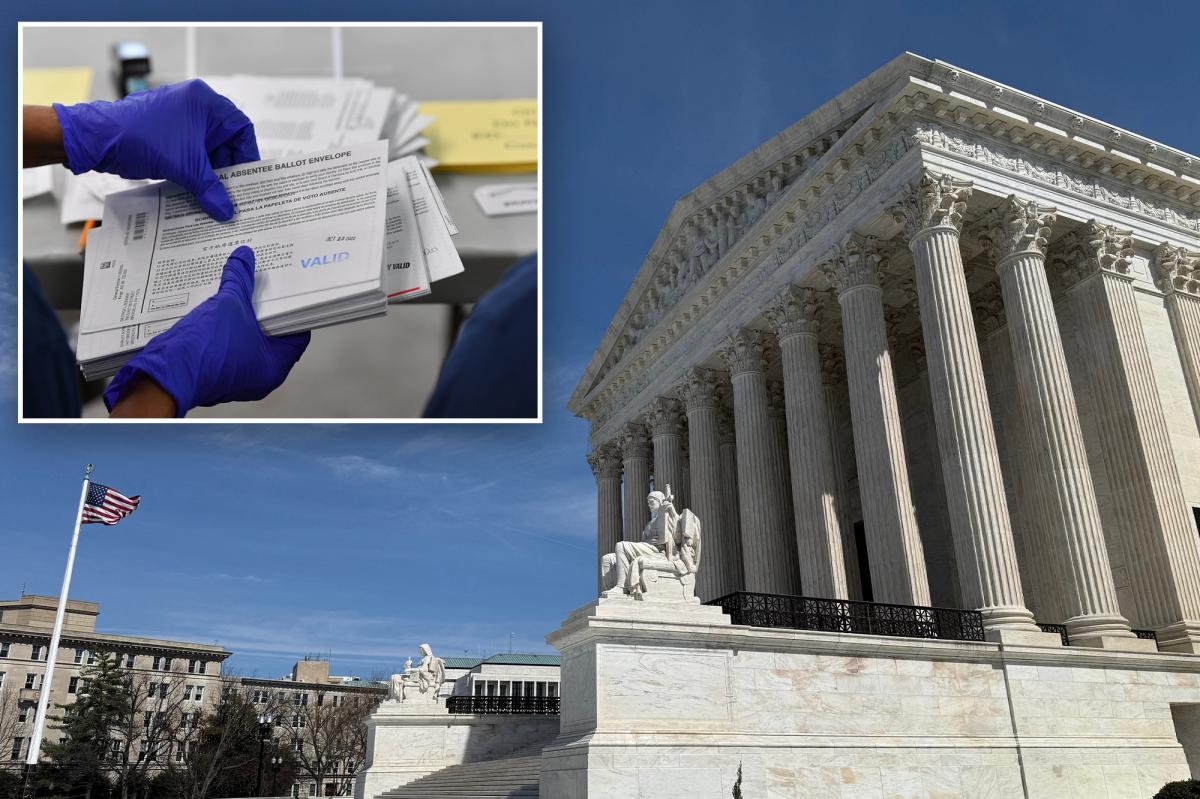

WASHINGTON — Mississippi’s solicitor common was caught flat-footed throughout oral arguments in a vital mail-in-ballot case earlier than the Supreme Courtroom Monday, prompting liberal justices to step in to assist him out.
Scott Stewart — who efficiently argued the 2022 case Dobbs v. Jackson Ladies’s Well being, through which the courtroom struck down Roe v. Wade — was staggered by hypothetical questions from conservative justices whereas defending a Magnolia State legislation permitting the counting of mail-in ballots as much as 5 days after voting closes, as long as they’re postmarked by Election Day.
After Trump-nominated Justice Amy Coney Barrett pressed Stewart about whether or not states may permit voters to recall mailed ballots earlier than Election Day, liberal Justice Ketanji Brown Jackson intervened.
“This case shouldn’t be a couple of Mississippi apply or coverage associated to recalling ballots,” stated Jackson, who added that she was “a bit of confused about these sorts of coverage questions.”
The most recent justice instructed Stewart that the longtime apply of permitting states to run their very own elections “really is pointed in your favor.”
The distinctive case pitted the pink state of Mississippi in opposition to the Republican Nationwide Committee, state Libertarian Celebration, and Trump administration, all of whom opposed the pandemic-era coverage.
A minimum of 14 different states have related legal guidelines — together with California, New York and Texas. Almost 30 states have grace intervals for absentee ballots, that are most frequently utilized by the army and US residents abroad.
In one other change, Justice Neil Gorsuch requested Stewart whether or not states may permit a voter to movie themselves postmarking a poll on Election Day, then have their brother submit it three weeks later.
“Why do you combat the premise?” Justice Sonia Sotomayor interjected after the Mississippian admitted he had “some issues” about that situation.
“If the state needs to make [a relative] a notary … a army officer, if it needs to make it a Supreme Courtroom justice, if it needs to make it anybody, so long as it’s executed by Election Day, that’s what’s counts, appropriate?” she contined.
Conservative Justice Samuel Alito then instructed Stewart that Sotomayor was “asking you what, I believe, she intends to be a pleasant query.”
All three Democrat-appointed justices sounded sympathetic to Mississippi, whereas conservative justices Gorsuch, Alito, Clarence Thomas, and Brett Kavanaugh appeared to lean in the direction of overturning the state legislation.
Paul Clement, representing the Libertarian Celebration of Mississippi, argued that by setting the primary Tuesday after the primary Monday in November as a nationwide Election Day in 1845, Congress inherently required that voting wrap up on that day.
“If anyone in Gulfport the day after the election asks, ‘Is the election over?’ the frequent sense reply is, ‘No it’s not, the ballots are nonetheless coming in,” Clement argued. “That actuality provides the mislead the concept now we have a uniform nationwide election day.”
On the identical time, the legal professional insisted he was not arguing to make early voting unlawful, a degree with which all sides agreed.
The case, Watson v. RNC, comes amid President Trump’s push for Congress to tighten restrictions on mail-in ballots and enact a proof of citizenship requirement to vote in federal elections as a part of the Safeguard American Voter Eligibility (SAVE) America Act, which faces an uphill battle within the Senate.
A choice is predicted by the tip of June.
