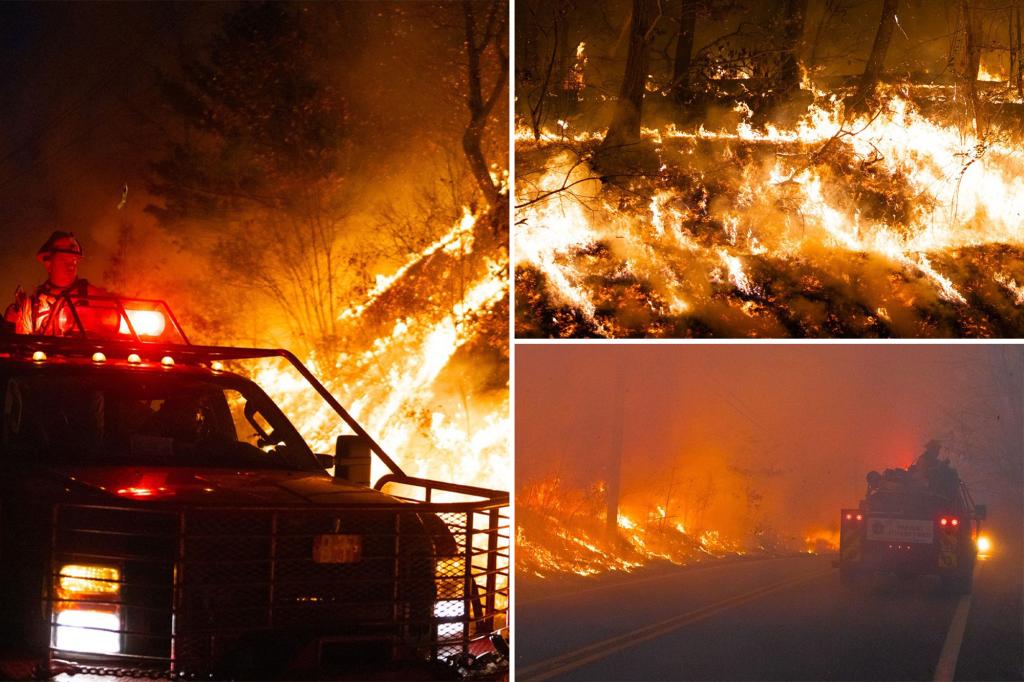

A whole bunch of firefighters from New York and New Jersey are struggling to include a mammoth wildfire that straddles the 2 states, and it has already torched some 3,000 acres — an space about three and a half instances the dimensions of Central Park.
The Jennings Creek Fireplace — the biggest of 9 blazes which have erupted throughout the bone-dry Backyard State over the past week or so — is refusing to quietly die down. After 4 days, it’s nonetheless raging alongside Greenwood Lake’s japanese edge — simply 30 miles northwest of Midtown Manhattan.
Crews had contained about 10% of the burn on Monday. Flames threaten 14 buildings in Greenwood Lake, New York, and 10 in New Jersey — together with in a historic district outdoors West Milford.
The fires had been fueled by winds and the driest situations within the New York Metropolis space since data started in 1865 — across the finish of the Civil Struggle, in accordance with Fox Climate.
The quarter-inch of rain that fell in a single day Sunday gave crews in West Milford, New Jersey, and Orange County, New York, a much-needed break — however they had been again at it once more within the morning, preventing the mushrooming inferno with the assistance of a number of water-carrying helicopters.
“We’re throwing every thing we’ve obtained at it, and we’re making progress,” Christopher Franek, an assistant division warden with the hearth service, advised The Publish on Monday. “However we’re being cautious as a result of that is excessive hearth hazard.”
Regardless of their heroic efforts, the blaze continues to be uncontrolled.
“It’s extraordinarily rugged terrain,” Franek mentioned of the northern Appalachian vary the place there are few roads and even mountain climbing trails.
“That’s making entry to go struggle the hearth laborious — it’s laborious to get tools in there. Some areas are too steep for bulldozers,” he mentioned. “So it’s someone on the bottom, digging hearth traces, choking on smoke and dirt, making an attempt to suppress this fireplace with guide labor.”
The NJ Forest Fireplace Service has been working hand-in-hand with the New York Division of Environmental Conservation’s Division of Forest Safety and Fireplace Administration to coordinate the response, which includes a myriad of native departments.
The 300 or so New Jersey firefighters have been joined by 277 first responders on the New York aspect, which incorporates firefighters from 44 firms; six legislation enforcement businesses; and 4 EMS crews, the New York DEC mentioned.
There are additionally 4 helicopters hovering overhead: two from the New York State Police and two UH-60M Blackhawks from the New York State Division of Army and Naval Affairs.
The Blackhawks can carry 660 gallons of water, which they’re utilizing to douse the woodland inferno that sparked up throughout a prolonged drought that’s left the forests dry — and ripe for disaster.
It’s not clear what began the hearth or by which state it started.
Walter Nugent, chair of the Fireplace Science division at New Jersey Metropolis College, advised The Publish on Monday that firefighters have two essential methods to struggle such epic blazes: douse them in water and starve them of gas.
That implies that as they dump water on the flames, they’ve to tear up the underbrush to create a firebreak.
“It’s important to cool and quench, and you need to take away the hearth load,” Nugent mentioned. “You say, ‘Properly, what’s burning now? What else has the potential?’ For those who can probably make a break … that helps.”
He added that the mountainous, rugged topography of northern New Jersey and southern New York could make a tough job even tougher.
“You might have pure blocks that you would be able to’t get by, or you could possibly get to sure areas, however you need to hike for a way lengthy simply to get there,” he mentioned. “It’s extraordinarily troublesome, and every thing relies on the terrain itself.”
However there are some issues working in firefighters’ favor — particularly, that Monday hasn’t been significantly windy.
“If it was, it’s even worse,” Nugent mentioned, noting that vast outside fires simply unfold their embers, which catch on the wind currents and unfold the blaze additional.
So firefighters should use each geographic function they’ll to sluggish it down — together with mountains, roads, rivers and any patch of concrete that may act as a firebreak.
Franek, of the hearth service, mentioned that’s what they’ve been doing — and so they’re even utilizing shovels and leaf blowers to chop again the overgrowth from all roads that had been designed as firebreaks, however haven”t been utilized in ages.
It’s the identical story on the New York aspect, the DEC mentioned.
“DEC Forest Rangers are extremely skilled and have supported and responded to forest fires all through North America — together with Canada, Montana, Idaho and California,” the company mentioned.
“They’re as succesful as any within the west.”
